Whether you can swap your licence for an Irish one depends on the country that issued it. Ireland exchanges licences from EU and EEA countries and from a short list of "recognised states", including the UK, Australia, several Canadian provinces, Japan, South Korea, New Zealand and South Africa. If your licence comes from anywhere else, including most of Africa and South Asia, you cannot exchange it. You must learn to drive in Ireland and pass a test, although a shortened training route is available.
How long you can drive on a foreign licence
The National Driver Licence Service (NDLS) explains that a visitor can drive on a current, valid licence from outside the EU and EEA for up to 12 months. The rule changes once you take up "normal residence", which the NDLS defines as living here for 185 days or more in a calendar year due to your job and personal life. From then on you cannot drive on a non-EU licence. You must either exchange it or get an Irish licence.
Most foreign workers become normally resident soon after they arrive, so plan your licence early, especially if your job involves driving.
Countries Ireland exchanges licences with
Apart from EU and EEA countries, the NDLS list of recognised states is:
- Australia (each state and territory)
- Canada: Alberta, British Columbia, Manitoba, New Brunswick, Newfoundland and Labrador, Ontario and Saskatchewan
- Georgia, Gibraltar, Guernsey, Isle of Man, Japan, Jersey and Moldova
- New Zealand, the Republic of Korea, South Africa, Switzerland and Taiwan
- the United Kingdom and Northern Ireland
Each agreement has its own conditions. Licences from many Australian states and Canadian provinces are exchanged for automatic cars only, unless you prove you passed your test in a manual car. Taiwan and New Zealand exchanges cover only cars and motorcycles. Japanese and Korean licences need a translation from their embassies in Dublin.
A licence that was itself obtained by exchanging a licence from a non-recognised country cannot be exchanged in Ireland.
How to exchange a recognised licence
You can apply online or at an NDLS centre with an appointment. The main requirements are:
- your most recent licence from the recognised state, which must be handed in
- a completed eyesight report, which the NDLS requires for every non-EU exchange
- a medical report dated within the last three months, if your case requires one
- your PPS number and proof of address dated within the last six months, where needed
- proof that you are normally resident in Ireland, if you were born outside the EU, EEA, Switzerland and the UK
- the fee of €65
Some countries also require a Letter of Entitlement or driver statement from the issuing authority, dated within six months. This applies, for example, to South Africa and most Australian states. If it is not in English or Irish, you need a certified translation. A licence can be exchanged up to one year after it expires, with a Letter of Entitlement. If it expired more than a year ago, it cannot be exchanged.
The NDLS may contact the country that issued your licence to confirm it is valid, which can add several weeks. It warns of current delays with South African licences.
If your licence cannot be exchanged
Holders of licences from countries such as India, Nigeria, Kenya, Pakistan, the Philippines or the United States must follow the learning to drive process:
- pass the driver theory test, booked through the official theory test service
- apply for a learner permit (€45 for a first permit, according to the NDLS fee list)
- complete Essential Driver Training (EDT) with an approved instructor
- pass the driving test, then apply for a full licence (€65)
Experienced drivers get some help. Since January 2019, foreign licence holders who cannot exchange can apply for reduced EDT of at least six lessons instead of twelve. They can also apply to skip the usual six month wait before a first-time learner can sit the driving test. From 1 November 2026, reduced EDT can only be approved once. If you need to start again later, earlier lessons no longer count and you must complete all twelve.
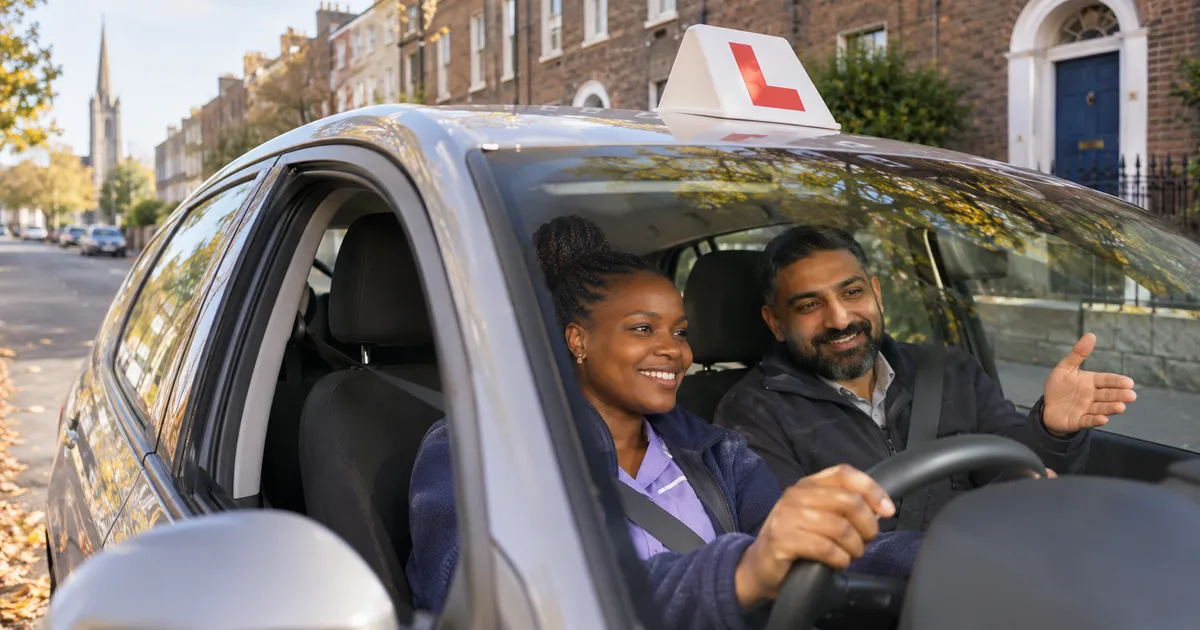
Once you hold an Irish learner permit, it takes priority over your foreign licence. You must display L plates and follow all learner rules, including driving only with an accompanying qualified driver.
Professional drivers
If you drive trucks or buses, extra rules apply. Licence holders under 21 for categories C and CE, or under 24 for D and DE, need a Certificate of Professional Competence (CPC). You exchange your other categories first, then complete CPC and add the truck or bus categories within one year of the exchange.
Driving abroad later
Once you hold an Irish licence, you can apply for an International Driving Permit if you need to drive in a country that requires one. Ireland issues permits under the 1949 and 1926 UN conventions.
Questions people ask
Can I drive in Ireland on my foreign licence?
Yes, as a visitor for up to 12 months. Once you are normally resident, you must exchange your licence or get an Irish one.
Which countries can exchange licences in Ireland?
EU and EEA countries plus recognised states such as the UK, Australia, several Canadian provinces, Japan, South Korea, New Zealand, South Africa, Switzerland and Taiwan.
How much does it cost to exchange a driving licence in Ireland?
The NDLS fee for exchanging a foreign licence is €65.
Can I exchange an Indian or Nigerian licence in Ireland?
No. Holders must pass the theory test, get a learner permit, complete driver training and pass the driving test.
What is reduced EDT?
Foreign licence holders who cannot exchange can apply to take at least six driving lessons instead of twelve, and to skip the six month wait before the test.
Official sources: NDLS: Exchange my foreign driving licence, NDLS: Fees, NDLS: Do I need to submit an eyesight report form?, RSA: Driver theory test, NDLS: International Driving Permit