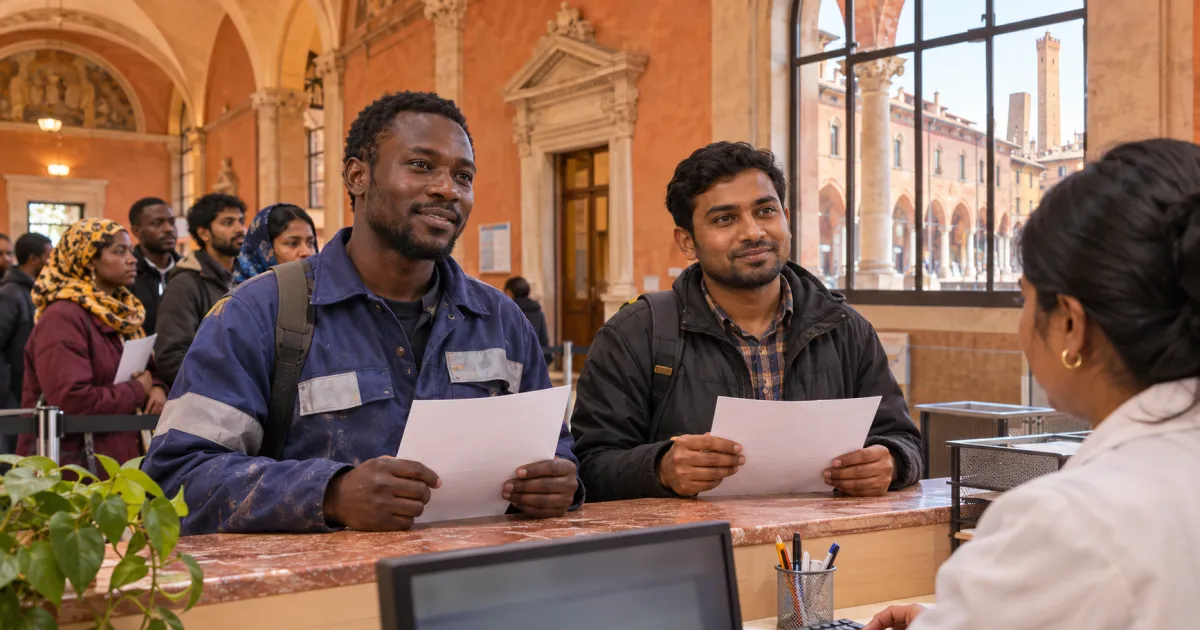
Your first month in Italy is mostly paperwork, and the order matters. If you come from outside the EU and will stay more than three months, you must apply for a residence permit within 8 days of entering the country. You also need a tax code, the codice fiscale, which almost everything else depends on: your job contract, a bank account, a phone line, a lease and your health card.
Week one: the residence permit
The permesso di soggiorno is the document that lets you live and work in Italy after your visa. Poste Italiane explains that most applications start with a yellow banded kit, collected at any post office and handed back with your documents. Workers hired from abroad usually sign a residence contract at the immigration desk of the local prefecture first, so ask your employer which step comes first in your case.
When you hand in the kit, the post office lists these costs:
- A revenue stamp of €16, bought at a tobacconist
- €30 paid at the counter for the postal service
- €30.46 for producing the electronic permit card, plus any contribution that applies to your permit type
You get two papers back: a receipt that proves you applied, and a letter with a date to visit the Questura, the police headquarters. Keep both safe. The receipt works as proof of legal stay while your card is made, and it contains codes to follow your file online. At the Questura appointment you bring photos, and the Polizia di Stato says first time applicants are fingerprinted.
The forms are in Italian. You can get free help filling them in at a patronato, a workers' advice office, or at some town halls.
The codice fiscale
The codice fiscale is a 16 character code that identifies you to the state. According to the Revenue Agency, people who enter for work are usually given it by the immigration desk, the Sportello Unico, during their entry procedure. Otherwise the Questura or any Revenue Agency office can issue it. Ask for it early, because your employer cannot put you on the payroll without it.
Registering where you live
Once you have a stable address, register your residence at the anagrafe, the registry office of your town hall. Registration gives you a certificate of residence, which banks, schools and doctors often ask for. A municipal officer may visit to check that you really live at the address, so make sure your name is on the door or letterbox.
Opening a bank account
Your salary will normally be paid into an Italian account. Every bank must offer a basic account, the conto di base. The Banca d’Italia says banks must open one for anyone with the right to stay legally in Italy or another EU country, including asylum seekers. It has a fixed list of services for a low annual fee, and it is free for people with an ISEE family income indicator below €11,600.
Take your passport, codice fiscale and permit or postal receipt. Some banks will also ask for your work contract or proof of address.
Getting a SIM card
Italian mobile operators must identify each customer before activating a line. Bring your passport and codice fiscale to a phone shop. Prepaid plans are common and need no credit check, which makes them the easiest choice in your first weeks. Use the Italian number on your job, bank and health forms so you receive their messages.
Finding housing
Many new arrivals stay in a room or short let first, then sign a longer lease once they know the city. Before you pay, read the contract carefully. Under Law 392 of 1978, a landlord cannot ask for a security deposit above three months of rent, and the deposit earns legal interest. A proper lease must also be registered with the tax authority, so ask the landlord to show you the registration.
Italy has no single official average rent, but the Revenue Agency's Real Estate Market Observatory publishes rental values for zones in every town twice a year. Look up the zone of a flat you are offered and compare its price per square metre with the range shown.
Health card
Workers with a residence permit register with the national health service at the local health office, the ASL, and choose a family doctor. You then receive a health card that also shows your codice fiscale. It stays valid for up to six years or until your permit expires, so renew it together with your permit.
A simple first month checklist
- Days 1 to 8: hand in the permit kit or sign at the immigration desk
- Week 1: get the codice fiscale, give it to your employer
- Weeks 1 to 2: SIM card and basic bank account
- Weeks 2 to 4: lease, residence registration and ASL registration
Questions people ask
How soon must I apply for a residence permit in Italy?
Non-EU citizens staying over three months must apply within 8 days of entering Italy, usually with the yellow banded kit from a post office.
How much does the Italian residence permit cost?
Poste Italiane lists a €16 revenue stamp, €30 at the counter and €30.46 for the card, plus any extra contribution for your permit type.
Can I open a bank account with only a postal receipt?
Banks must offer a basic account to anyone with the right to stay legally. Many accept the receipt with your passport and codice fiscale, but ask the branch first.
What is the maximum deposit for a flat in Italy?
Law 392 of 1978 limits the security deposit to three months of rent, and the landlord owes you legal interest on it.
Where do I get a codice fiscale?
Workers usually receive it from the immigration desk during the entry procedure. The Questura or any Revenue Agency office can also issue it.
Official sources: Poste Italiane: Guide to obtaining and renewing residence permits, Polizia di Stato: How and where a foreign national can obtain a residence permit in Italy, Agenzia delle Entrate: Tax identification number for foreign citizens, Banca d'Italia, Economia per tutti: Il conto di base, Normattiva: Law 392 of 1978, article 11 (security deposit), Agenzia delle Entrate: Italian Real Estate Market Observatory, Agenzia delle Entrate: Health card